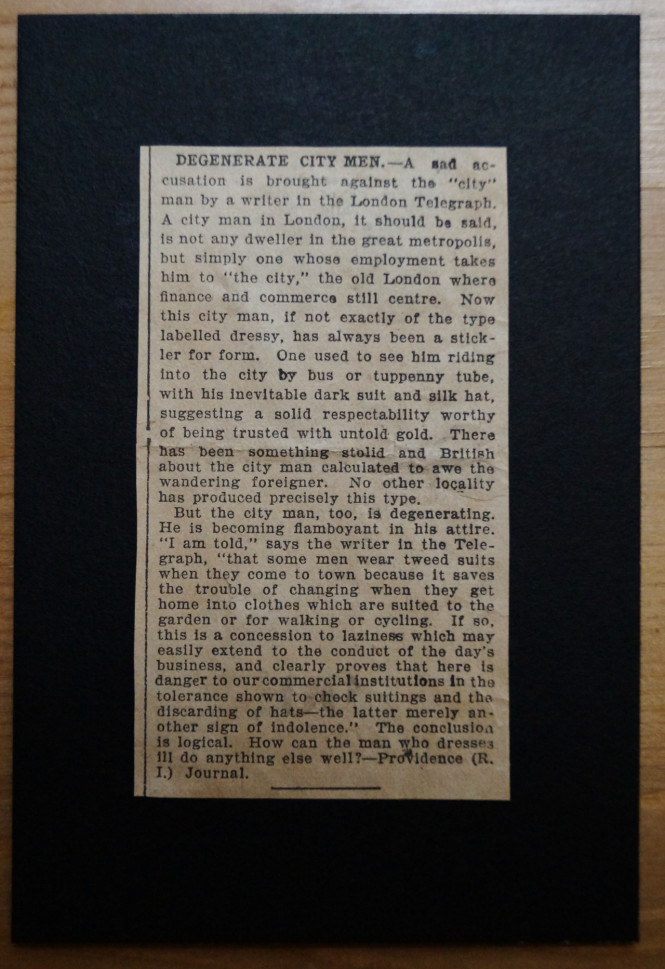
This little article spends its time in a tiny frame, hung in a place of honor in my apartment. My roommate discovered it inside a completely intact New York Times paper he found on a construction site in Manhattan. The article is from 1906. The second paragraph is amazing. A must read for the menswear-inclined.

DEGENERATE CITY MEN. - A sad accusation is brought against the “city” man by a writer in the London Telegraph. A city man in London, it should be said, is not any dweller in the great metropolis, but simply one whose employment takes him to “the city,” the old London where finance and commerce still centre. Now this city man, if not exactly of the type labelled dressy, has always been a stickler for form. One used to see him riding into the city by bus or tupenny tube, with his inevitable dark suit and silk hat, suggesting a solid respectability worthy of being trusted with untold gold. There has been something stolid and British about the city man calculated to awe the wandering foreigner. No other locality has produced precisely this type. 
But the city man, too, is degenerating. He is becoming flamboyant in his attire. “I am told,” says the writer in the Telegraph, “that some men wear tweed suits when they come to town because it saves the trouble of changing when the get home into clothes which are more suited to the garden or for walking or cycling. If so, this is a concession to laziness which may easily extend to the conduct of the day’s business, and clearly proves that here is danger to our commercial institutions in the tolerance shown to check suitings and the discarding of hats - the latter merely another sign of indifference.” The conclusion is logical. How can the man who dresses ill do anything else well?

This little article spends its time in a tiny frame, hung in a place of honor in my apartment. My roommate discovered it inside a completely intact New York Times paper he found on a construction site in Manhattan. The article is from 1906. The second paragraph is amazing. A must read for the menswear-inclined.

DEGENERATE CITY MEN. - A sad accusation is brought against the “city” man by a writer in the London Telegraph. A city man in London, it should be said, is not any dweller in the great metropolis, but simply one whose employment takes him to “the city,” the old London where finance and commerce still centre. Now this city man, if not exactly of the type labelled dressy, has always been a stickler for form. One used to see him riding into the city by bus or tupenny tube, with his inevitable dark suit and silk hat, suggesting a solid respectability worthy of being trusted with untold gold. There has been something stolid and British about the city man calculated to awe the wandering foreigner. No other locality has produced precisely this type. 

But the city man, too, is degenerating. He is becoming flamboyant in his attire. “I am told,” says the writer in the Telegraph, “that some men wear tweed suits when they come to town because it saves the trouble of changing when the get home into clothes which are more suited to the garden or for walking or cycling. If so, this is a concession to laziness which may easily extend to the conduct of the day’s business, and clearly proves that here is danger to our commercial institutions in the tolerance shown to check suitings and the discarding of hats - the latter merely another sign of indifference.” The conclusion is logical. How can the man who dresses ill do anything else well?

Out & About: Wingtip

The Financial District of San Francisco is an interesting place. I’m there all week but I rarely venture over during the weekend as it generally becomes quite desolate and empty without the bustle of business. However, I decided to change that and went on a weekend visit to the infamous Wingtip (formerly On the Fly), now located in the shadow of the Transamerica tower in the historic Bank of Italy building.

Now, before I even get in to talking about the store I think it’s worth giving a bit of background on the Bank of Italy building. As someone who designs buildings for a living I think it adds a nice bit of context to the whole experience. 

The bank of Italy was founded in 1904 by the Italian-American Amadeo Giannini, a produce buyer living in San Mateo. Although he led a successful career, he found that San Francisco’s financial system had a philosophy of “big banks for big people,” making it near impossible for common men and women to find a loan. This often pushed these people towards seedy loan sharks and other dangerous companies. The fact that the financial capital of the West would finance millions of dollars for a railroad and would refuse $50 for a farmer’s home improvement was infuriating to him, and so he single-handedly created a “bank of the people” that would choose customers based on their character, not by their net worth. This small, simple idea was exactly what the Bay Area needed, and the young bank was an instant success with common men and women all over the state. The bank is now commonly known as the Bank of America. Without Giannini’s simple startup the landscape of banking as we know it would be radically different; his work helped democratize banks and bring them to the individual level.

The Bank of Italy building was built in 1908 after the 1906 earthquake and subsequent fire destroyed the original bank on Columbus Avenue. The beautiful building served as the headquarters of Giannini’s company until 1921, at which point the company had outgrown the structure and moved to a new location. It has housed several banks in the interim and is now a National Historic Landmark. Through some miracle, a classy men’s store was able to nab the space for their own use, and the rest, as they say, is history.

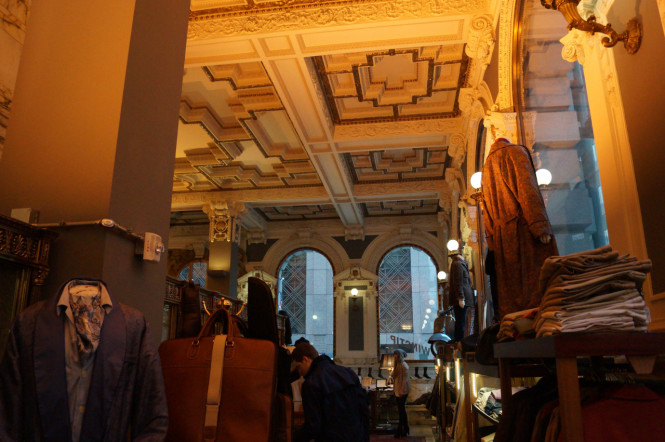
The first thing you will notice when entering Wingtip is the architecture. The soaring marble ceilings and enormous windows contrast the thick steel vault doors and brass fixtures. You’ll probably stand around for a few minutes looking at the detailed molding before you realize that you’re actually in a well-curated men’s store. Bank vaults are lined with Luciano Barbera ties, marble hallways hide Alfred Sargent oxfords, and cashmere sweaters are piled on billiard tables and persian rugs. The main floor holds the ready-to-wear clothing and accessories, and the underground bank vault is home to the bespoke level - dozens of Holland and Sherry fabric books litter the walls like ancient tomes, and each of the locked drawers in the bank vault hold the information for a single bespoke customer. The second floor carries the elite member-only club - more on this soon.

So whether you need an alligator belt, badger brush, bespoke Prince of Wales flannel suit, or just want to look at the scenery, trot over to Wingtip and take a look. I have yet to make a substantial purchase there, but it has become my go-to for Saphir  - the lovely french shoe products that are almost impossible to find in a brick-and mortar store. If you’re in the area I highly suggest that you take a look sometime, whether you’re planning on dropping big bucks or not.

Wingtip also has a web store that can be found here.

Personal Style, Part I: Know Your Roots 
This is the first installment in a series about events that shaped the way I dress. These stories may or may not be relevant to you but hopefully they offer a perspective that isn’t often seen on the internet. 
One mantra we all hear a lot in the #menswear community is the importance of finding your own personal style and to avoid being “dressed by the internet.” There is a huge amount of knowledge out there, to be sure, but it can lead to a canned sense of ‘personal style’ if you only wear what people tell you to. 
I grew up with no style influences whatsoever, be them from within my family or pop culture. My parents had little money and no interest in classic style and my small hippie west coast town had nothing to add to the equation. I always had a strong desire to dress well, but no knowledge or resources to help me properly execute this interest. Since my father wasn’t able to teach me how to shop for suits or tie a four-in-hand, I turned to the internet for guidance. I learned quite a bit, but I still felt disconnected from this new world of luxury items and father-to-son knowledge. My relationship with men’s style was a hollow connection; I wasn’t Italian, I didn’t go to boarding school, and I had no friends that held a similar interest. Clothing had become a great hobby, but at times it felt inauthentic. 
My grandfather, on the other hand, had a very different upbringing. He grew up in the Midwest in a privileged family, spent his youth at Andover Academy, and ended up attending Notre Dame after a stint in WWII. After a long and successful business career he settled in Wyoming, where he was known for his outdoor prowess, horseback riding expertise, and deadly golf skills. He passed away several years ago and I always knew him as a grand adventurer, charming cowboy, and loving granddad.  It was not until recently that I began to see that we had more in common than I had once thought.
During a trip home a while back I happened upon my grandfather’s old wardrobe in the back of my own childhood closet, dusty and untouched for years. I was startled to find that every item I saw was immediately recognizable with my newfound knowledge: gray flannel suit, Harris Tweed sport coats, OCBDs in all the right colors, a Brooks Bros. blue blazer, gingham shirts, khakis, leather-soled shoes, a white linen pocket square, hell, even an Omega Seamaster that he wore every day. It was as if a #menswear list of essentials had appeared in my closet during my absence.
I dug up some old photo albums to verify what I hoped to be true but refused to believe. In doing so I found hundreds of vintage photographs portraying my grandfather in beautiful sack suits, perfectly tailored tweed blazers, and dozens of bowties (apparently as my grandfather aged he refused to wear traditional ties - it was bowties or bolo ties every day). I reached out to my relatives to confirm; was it really true? Was my own grandfather really the stylish rouge I was seeing in these photographs, long before the internet and #menswear even existed? Friends and family from all over confirmed my suspicions and added their own stories of my grandfather’s infamous classic taste and preppy style. It was an emotional moment for me; I was deeply saddened that my grandfather and I could not share in this common passion during his lifetime, but the discovery left me happy to learn that my new hobby was not as separated from my heritage as I had once thought. Finding someone in my own family with the same desire to present themselves well - even if only through vintage photographs and old tweed jackets - was more than I ever could have hoped to discover.
Don’t be afraid to look in the closets and photo albums of your own family; just because your crazy uncle only wears sweatpants and sneakers now doesn’t mean that he never had a classy streak himself. Look into your own past and you might just stumble upon some treasures of your own.
Above: my granddad in his youth wearing herringbone tweed, a white polo collar shirt, and a black (or navy?) grenadine tie. Some styles really do transcend our own generation.
For J.A.P. Jr, 1919-2008

Personal Style, Part I: Know Your Roots 

This is the first installment in a series about events that shaped the way I dress. These stories may or may not be relevant to you but hopefully they offer a perspective that isn’t often seen on the internet. 

One mantra we all hear a lot in the #menswear community is the importance of finding your own personal style and to avoid being “dressed by the internet.” There is a huge amount of knowledge out there, to be sure, but it can lead to a canned sense of ‘personal style’ if you only wear what people tell you to. 

I grew up with no style influences whatsoever, be them from within my family or pop culture. My parents had little money and no interest in classic style and my small hippie west coast town had nothing to add to the equation. I always had a strong desire to dress well, but no knowledge or resources to help me properly execute this interest. Since my father wasn’t able to teach me how to shop for suits or tie a four-in-hand, I turned to the internet for guidance. I learned quite a bit, but I still felt disconnected from this new world of luxury items and father-to-son knowledge. My relationship with men’s style was a hollow connection; I wasn’t Italian, I didn’t go to boarding school, and I had no friends that held a similar interest. Clothing had become a great hobby, but at times it felt inauthentic. 

My grandfather, on the other hand, had a very different upbringing. He grew up in the Midwest in a privileged family, spent his youth at Andover Academy, and ended up attending Notre Dame after a stint in WWII. After a long and successful business career he settled in Wyoming, where he was known for his outdoor prowess, horseback riding expertise, and deadly golf skills. He passed away several years ago and I always knew him as a grand adventurer, charming cowboy, and loving granddad.  It was not until recently that I began to see that we had more in common than I had once thought.

During a trip home a while back I happened upon my grandfather’s old wardrobe in the back of my own childhood closet, dusty and untouched for years. I was startled to find that every item I saw was immediately recognizable with my newfound knowledge: gray flannel suit, Harris Tweed sport coats, OCBDs in all the right colors, a Brooks Bros. blue blazer, gingham shirts, khakis, leather-soled shoes, a white linen pocket square, hell, even an Omega Seamaster that he wore every day. It was as if a #menswear list of essentials had appeared in my closet during my absence.

I dug up some old photo albums to verify what I hoped to be true but refused to believe. In doing so I found hundreds of vintage photographs portraying my grandfather in beautiful sack suits, perfectly tailored tweed blazers, and dozens of bowties (apparently as my grandfather aged he refused to wear traditional ties - it was bowties or bolo ties every day). I reached out to my relatives to confirm; was it really true? Was my own grandfather really the stylish rouge I was seeing in these photographs, long before the internet and #menswear even existed? Friends and family from all over confirmed my suspicions and added their own stories of my grandfather’s infamous classic taste and preppy style. It was an emotional moment for me; I was deeply saddened that my grandfather and I could not share in this common passion during his lifetime, but the discovery left me happy to learn that my new hobby was not as separated from my heritage as I had once thought. Finding someone in my own family with the same desire to present themselves well - even if only through vintage photographs and old tweed jackets - was more than I ever could have hoped to discover.

Don’t be afraid to look in the closets and photo albums of your own family; just because your crazy uncle only wears sweatpants and sneakers now doesn’t mean that he never had a classy streak himself. Look into your own past and you might just stumble upon some treasures of your own.

Above: my granddad in his youth wearing herringbone tweed, a white polo collar shirt, and a black (or navy?) grenadine tie. Some styles really do transcend our own generation.

For J.A.P. Jr, 1919-2008