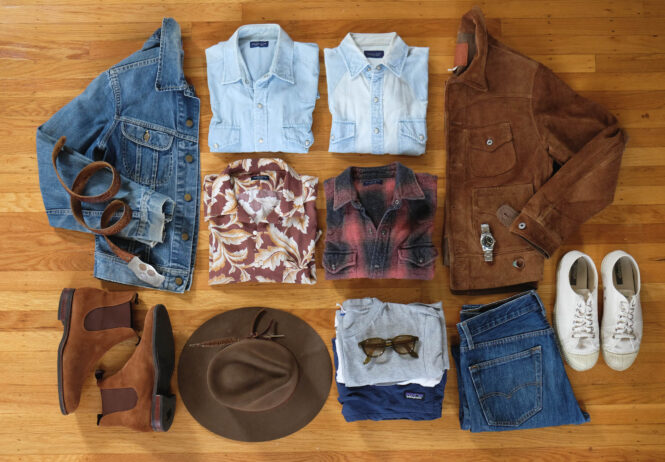
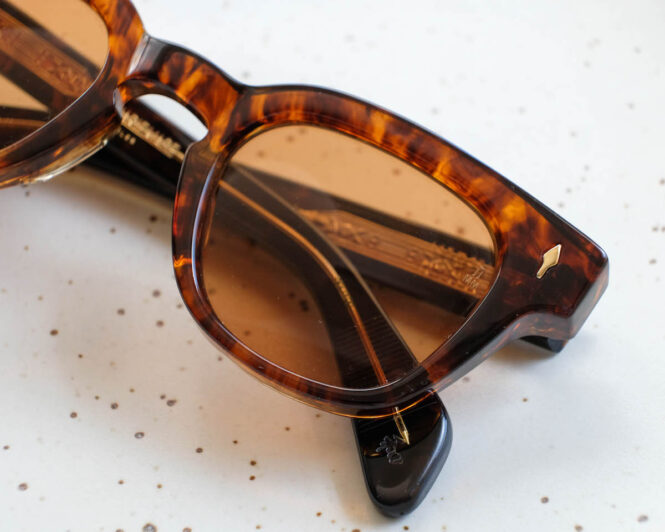
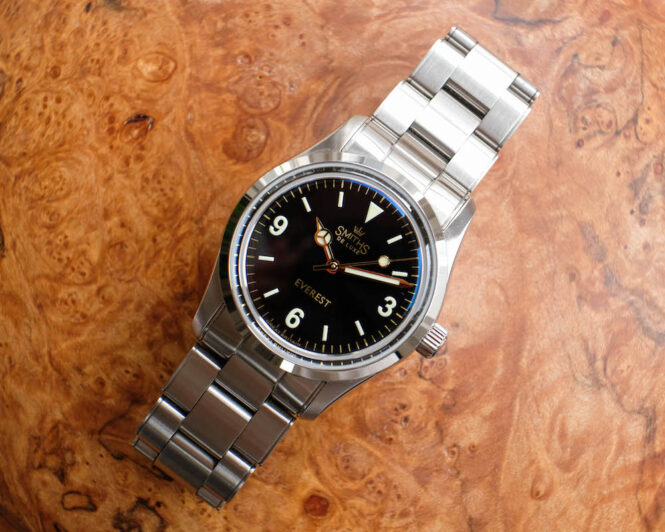
The newest addition to my collection of Equus belts - the “Scott” Oak Bark harness leather belt. It’s a rugged and handsome piece made to a unique set of criteria: withstand abuse from weather, use, and time, provide the strength to support tools, and look good while doing it. It has a rich mottled color similar to the Oak Brown belt I own, but in a much deeper hue that is difficult to photograph. The harness leather has a slightly more casual look and feel to it, possibly due to the high amounts of grease used in the tanning process (for added tensile strength) and the more rugged leather used. I’ve found that it’s an ideal belt for denim, as seen here. Charlie, the founder of Equus Leather, says he wears this belt almost every day and I can see why.

Bottom picture: Scott (left), Oak Brown (mid), and Australian Nut (right)

Thanks, Charlie!

I’m heading off to an epic bachelor party in Austin, TX. If you don’t hear back from me within a week somebody will need to call up my mom and tell her the bad news.
Here’s what I packed for a trip full of hot weather adventures, outdoor shenanigans, and other mischief. 
Off-white chinos
Khaki shorts
Swim trunks
Navy polo
Navy V-neck tee
Navy/white stripe linen shirt
Light blue gingham spread collar dress shirt
Navy knit tie (just in case)
Cotton navy blazer
Beat up sneakers
Penny loafers
Belt
Not shown: copious amounts of sunscreen
Lots of blue, lots of white. Lightweight fabrics and casual styling. Pretty simple.
(my other packing posts are here)

I’m heading off to an epic bachelor party in Austin, TX. If you don’t hear back from me within a week somebody will need to call up my mom and tell her the bad news.

Here’s what I packed for a trip full of hot weather adventures, outdoor shenanigans, and other mischief. 

  • Off-white chinos
  • Khaki shorts
  • Swim trunks
  • Navy polo
  • Navy V-neck tee
  • Navy/white stripe linen shirt
  • Light blue gingham spread collar dress shirt
  • Navy knit tie (just in case)
  • Cotton navy blazer
  • Beat up sneakers
  • Penny loafers
  • Belt

Not shown: copious amounts of sunscreen

Lots of blue, lots of white. Lightweight fabrics and casual styling. Pretty simple.

(my other packing posts are here)

A Closer Look at Beckett & Robb

Part II: Measurements and Fitting

Previously: Part I

After poring over fabric books, lapel styles, and horn buttons for a couple hours with Dustin I was ready to begin the most important part of the made-to-measure experience - the fitting. Picking fabric and style options is lots of fun (although my choices were very tame), but the most crucial part of the process is making sure that you are properly measured. 

Beckett & Robb’s measurement process consists of many body measurements as well as garment adjustments taken from some standard-sized suits in the store. The measurements are very thorough and account for a variety of parameters outside of what the standard online MTM companies offer. Things like shoulder slope, posture, sleeve pitch, button stance, and trouser rise (both front and back) are all very important to a well-fitting suit but are generally not captured in a “blind” MTM experience since they are difficult to determine with a measuring tape. Of course, I have yet to see how the final product incorporates these values but it was good to know that they were acknowledged and included. 

The suit samples (made of a Loro Piana grey worsted wool) were helpful in that they gave a general idea of what the final product might look like. My suit won’t look that similar to the sample I worked with (no skinny lapels, for instance), but it helped me see changes in real time and how they might affect the end product. For instance, button stance is a powerful factor in a suit’s look but it can be hard to visualize. The samples allowed me to see the effects of moving it up and down directly (I moved it down to a slightly more traditional level). 

One particular area that Dustin and I spent a lot of time poring over was my shoulders and deciding how to best address them. You see, although I have a slim build I have surprisingly broad shoulders with a heavy slope. The slope in particular causes problems and is difficult to address well. In the end we went with a lightly padded shoulder that hopefully will address my heavy slope in an attractive way. I know shoulders with any padding at all seem almost passé at the moment but it’s a classic silhouette (especially for a suit) and at the end of the day I relate more with the British tailoring traditions than with the Neopolitan style that is so popular nowadays. I am a descendant of Caledonia and the Emerald Isles, after all. Anyway, I’m curious to see how they turn out. 

All in all, Dustin was very capable and seemed to have a good handle on what he was doing. It should go without saying that the end result can only be as good as the person measuring it (which is why blind MTM suits can be so risky), so I was pleased that Dustin and I had similar taste and wanted the same things from the fitting. I was also able to rely on Dustin when my own knowledge was lacking - although I like to pretend to have a wealth of knowledge on things like this there are certainly topcis I don’t fully understand and Dustin was able to offer good advice when needed.

As could be expected from a perfectionist like myself, I find it easy to work myself into a tizzy about whether the suit will fit right or not. To me, though, that’s almost part of starting a clothing commission with a new company - the fear and excitement of waiting for a product being made solely for you. My suit should be arriving in the next week or two, so we’ll soon find out.

Anonymous asked: Hi there. As a local guy I'm seeking your advice for my wedding tuxedo. I'm deciding between Spoon Tailor, Proper Suit, and Becket & Robb. Do you have any thoughts or insight from you experiences? I like the idea of multiple fittings with Spoon, but Proper seems to do a bunch of weddings. Anyone else I should look at? Thanks

Those all sound like good options. I don’t own products from these companies myself, although I do have a project in the works at Beckett & Robb (see here). I have seen garments from all three makers on other people and most have looked good. I suppose if I were you I would call around and get some more information about tuxedos directly from these companies. Try and find out things like lead time, cost, and then any other criteria that is important to you (fabric availability, construction options, etc). For instance, Proper Suit has a $100 upcharge for tuxedos and also is only in town for limited periods of time (I believe they stop by end of June). Since you have the opportunity to work with someone locally it might be easier to take advantage of that and have more one-on-one time at the fittings. Of course, if Proper Suit offers the best option for your needs then by all means go for it. Other than, that, I think all of those could work out well and are probably around the same pricepoint. Good luck and enjoy the process! Let me know how it goes.

Shaving like a Gentleman - A few tips
It should go without saying that part of living a stylish life involves a good grooming regimen. Like many #menswear folks, I abandoned modern shaving technology a few years back and began using safety razors and a shaving mug (it should come as no surprise that it was inspired in part by Put This On’s segment on grooming). The experience has definitely improved my opinion of the shaving process, but I find that even after a few years the results I get are still somewhat varied. Sometimes I’ll get a great lather and a wonderful shave and others I’ll get less than magnificent results.
Over the weekend I stopped by my local barber for a quick trim (for the time being he will rename nameless since I have enough trouble getting an appointment already and don’t need any more competition). He’s a real pro and also offers straight razor shaves to his customers along with traditional haircuts. I’ve never gotten one, but since he clearly knows his stuff I took the opportunity to ask him for tips while I was getting my ears lowered. Here’s what he had to say.
First off, the preparation for the shave is of critical importance. Here’s how he recommends setting up: fill your mug with piping hot water, drop your brush head in, and let it sit for a few minutes. This achieves a couple of things. First, it helps moisturize the soap puck and allows it to deliver a rich, creamy lather. Secondly, and more importantly, it helps sterilize the brush. A damp brush is a potential breeding ground for bacteria and it is very important that you negate that risk. From my barber: “If you don’t make sure your brush is always clean then one day you’ll have a bacteria problem and rue the day that you used it to shave.” Wise words. In fact, I was informed that using shaving brushes in barber shops is illegal for that very reason - they are very difficult to disinfect. Historically, a barber would have a named brush and mug for each patron of their shop in order to keep everyone’s face clean and healthy.
Once you’ve thoroughly heated your soap puck and cleaned your brush you can pour out all of the remaining water (hold the puck down with the brush if it isn’t stuck to the bottom). The moisture left on the soap should be the perfect amount to get a rich lather going. Too much water will create a diluted and bubbly lather that isn’t well suited for shaving.
As for the physical act of shaving, my barber had surprisingly little to say. According to him, a good shave depends greatly on your own preferences and skill level. Do what is the most comfortable and effective for you - just be gentle to your skin.
When you’re done shaving it is important to wash and store your tools properly to ensure a clean and effective shave next time. Wash all of your tools off with cool water and let them dry in a open space. Make sure that your brush is hanging from its handle, not sitting on it. Hanging it upside down makes sure that it dries well, thus increasing its useful lifespan and keeping bacteria at bay. My barber underscored this several times: a freshly shaved face and bacteria does not end well. A wet brush sitting on its handle in a dark medicine cabinet is asking for trouble.
I asked his opinion on straight razors, since that is what he uses on his clients. He told me that it is a tool best left to the professionals. Straight razors are a tool that was created for someone to use on your face, not for personal use. A good straight razor is also prohibitively expensive and requires a complex maintenance regimen to be effective. If you’d like the straight razor experience then stop by your local barber’s chair to try it, he suggests. 
At the end of the day, a morning shave should be an enjoyable experience, whether it’s something that happens every day or only occasionally. Hopefully these expert tips will allow you to put your best face forward every time.

Shaving like a Gentleman - A few tips

It should go without saying that part of living a stylish life involves a good grooming regimen. Like many #menswear folks, I abandoned modern shaving technology a few years back and began using safety razors and a shaving mug (it should come as no surprise that it was inspired in part by Put This On’s segment on grooming). The experience has definitely improved my opinion of the shaving process, but I find that even after a few years the results I get are still somewhat varied. Sometimes I’ll get a great lather and a wonderful shave and others I’ll get less than magnificent results.

Over the weekend I stopped by my local barber for a quick trim (for the time being he will rename nameless since I have enough trouble getting an appointment already and don’t need any more competition). He’s a real pro and also offers straight razor shaves to his customers along with traditional haircuts. I’ve never gotten one, but since he clearly knows his stuff I took the opportunity to ask him for tips while I was getting my ears lowered. Here’s what he had to say.

First off, the preparation for the shave is of critical importance. Here’s how he recommends setting up: fill your mug with piping hot water, drop your brush head in, and let it sit for a few minutes. This achieves a couple of things. First, it helps moisturize the soap puck and allows it to deliver a rich, creamy lather. Secondly, and more importantly, it helps sterilize the brush. A damp brush is a potential breeding ground for bacteria and it is very important that you negate that risk. From my barber: “If you don’t make sure your brush is always clean then one day you’ll have a bacteria problem and rue the day that you used it to shave.” Wise words. In fact, I was informed that using shaving brushes in barber shops is illegal for that very reason - they are very difficult to disinfect. Historically, a barber would have a named brush and mug for each patron of their shop in order to keep everyone’s face clean and healthy.

Once you’ve thoroughly heated your soap puck and cleaned your brush you can pour out all of the remaining water (hold the puck down with the brush if it isn’t stuck to the bottom). The moisture left on the soap should be the perfect amount to get a rich lather going. Too much water will create a diluted and bubbly lather that isn’t well suited for shaving.

As for the physical act of shaving, my barber had surprisingly little to say. According to him, a good shave depends greatly on your own preferences and skill level. Do what is the most comfortable and effective for you - just be gentle to your skin.

When you’re done shaving it is important to wash and store your tools properly to ensure a clean and effective shave next time. Wash all of your tools off with cool water and let them dry in a open space. Make sure that your brush is hanging from its handle, not sitting on it. Hanging it upside down makes sure that it dries well, thus increasing its useful lifespan and keeping bacteria at bay. My barber underscored this several times: a freshly shaved face and bacteria does not end well. A wet brush sitting on its handle in a dark medicine cabinet is asking for trouble.

I asked his opinion on straight razors, since that is what he uses on his clients. He told me that it is a tool best left to the professionals. Straight razors are a tool that was created for someone to use on your face, not for personal use. A good straight razor is also prohibitively expensive and requires a complex maintenance regimen to be effective. If you’d like the straight razor experience then stop by your local barber’s chair to try it, he suggests. 

At the end of the day, a morning shave should be an enjoyable experience, whether it’s something that happens every day or only occasionally. Hopefully these expert tips will allow you to put your best face forward every time.

In Person: Gustin Denim

I’ve had the good fortune of hanging out with the Gustin crew a couple of times, and a few weeks ago they were kind enough to offer me a pair of their jeans for review. There’s been a good deal of hype around Gustin’s jeans (mainly because of the killer pricepoint and unique denim options) but since the great monetary value comes with a waiting period of a couple months that means relatively few people have actually experienced the product firsthand. I’ll try and lay out a detailed review for those that want more information before they’ll consider buying, but the short answer is that they’re a fantastic value.

The pair I left with is a 13.5 oz. Cone Mills raw selvage denim in their straight fit. The cut is slim through the seat and thighs and is a true straight leg form the knee down. The fit is comparable to my 3Sixteen SL100x but without the slight taper below the knee (7.7” measured opening on the 3Sixteens, about 8” on the Gustins). I’d say that in my limited experience it is reminiscent of the Levi’s 514 cut. Although I would probably prefer a slight taper below the knee (7.75” would be ideal, I think), I certainly don’t “need” it - the straight leg is a very classic style and gives a fairly “timeless” silhouette (although I admit that word is certainly overused). I will also get them hemmed after their first wash, and this will help reduce the bulk around the bottom as well. For what it’s worth, I have gotten several compliments on these jeans (most of which came from a very fashionable and “fabulous” neighborhood in San Francisco), and I’ve never been complimented on my denim before.

The rise on this pair is also comparable to my 3Sixteens - it is a bit higher than most denim on the market but I definitely like it where it is. For those that want a tapered, lower-rise jean, Gustin offers a very slim option as well. I might bite at something in between the two, but the slim fit measurements look a bit too extreme for me. 

For my pair, the denim itself is fairly “average,” as far as high-end selvage goes. This standard Cone Mills denim isn’t really that unique - it’s a mid-weight, true indigo, regular-feeling, red-line selvage. However,  this shouldn’t be taken as a dig against the product. Gustin offers jeans in more fabrics than I knew existed - heavy, light, green, black, organic, and any other sample they can get their hands on. If you don’t see anything you like then simply wait a week or two. For the record, I’ve heard especially good things about their Japanese denim, and if the fabric swatches I’ve felt are any indication then I have to agree.

Gustin denim has some slight detailing that make it unique - half-lined pockets (which is why there is a line across them), reinforced belt loops (sewn on before the waistband to increase strength), and impressively sturdy hardware (seriously - really nice stuff). The selvage belt loop and minimal pocket detailing might be too much for denim purists but I find that they are not detracting and the overall aesthetic is still subtle. As for the construction quality, I said it before but I’ll mention it again - these are literally (not figuratively) made alongside other brands that cost significantly more, right here in San Francisco. There is no reduction in material or construction quality. 

Now, the biggest difficulty when buying Gustin denim (besides the wait) is sizing. Since all of the denim is crowdsourced, the products are offered at a wonderful pricepoint because there is no need for holding inventory. However, the tradeoff is ease of returns (although Gustin is working hard to accommodate them), and for that reason sizing correctly is very important. As their website explains, Gustin jeans are made with a bit less vanity sizing than most brands, so some people may need to wear a bigger size than what they are accustomed to. On the other hand, many people suggest sizing down with raw denim to account for the stretching. Where does this leave us? For starters, I would not size down from your original size when buying Gustin jeans as this will result in a jean that is much tighter than you expect. I went true-to-size (31) with my pair, and they were very tight in the waist initially but have stretched out comfortably after a couple weeks of wear. Gustin’s chat board seems to come to a similar consensus. Of course, not all denim stretches the same amount and not everybody wants to deal with a super snug waistband, so again there is some uncertainty. I would suggest this: If you are a very constant waist size across the board and are used to buying raw denim tight and breaking them in, consider going true-to-size. If you are in-between sizes and/or don’t want to risk too-tight jeans, size up one. Don’t size down. Of course, that’s just my opinion - Gustin provides detailed measurements that you should definitely consult before making your decision.

All told, I think the Gustin team is putting out some wonderful jeans. If their cut looks like something that would work for you then I would wholeheartedly encourage you to try a pair. This is far and away the most inexpensive way to get the high-end denim experience. The only thing separating these jeans from the other big brands is about  $140. 

PS - keep an eye out for new products in the coming weeks. I’ve seen some very cool samples that will hopefully be making their way to the website soon.

Anonymous asked: So I'm trying to pick up a few pairs of shoe trees, and it looks like Allen Edmonds carries a version that has a solid quality/cost ratio. My questions are: do AE shoe trees work for all of their lasts? Would it be fine to put AE trees in a non-AE shoe (picked up on ebay)?

I’ve never had too much trouble with mismatching shoe trees with other makers. Allen Edmonds shoe trees will definitely work for all of their own lasts and for most other shoes - they’re fairly generic. I think that the Allen Edmonds trees are perfectly good - I have two or three pairs. However, Woodlore makes an essentially identical one that can go for much cheaper still  - they are at Sierra Trading Post right now, and with an easily-accessed coupon they’ll come down to near $10. Stock is low at the moment but that shouldn’t last too long.

Warm Weather Fabrics: Don’t Forget Wool
Now that most of us are well in to the warmer months we’re beginning to once again hear quite a bit about the classic spring/summer fabrics - cotton, linen, and seersucker. It isn’t hard to find a shirt made out of a light cotton or breezy linen, but when it comes to blazers, trousers and suits the game changes a bit. For tailored clothing, one material in particular will keep you just as cool without giving up formality - wool. It may sound counter-intuitive, but hear me out.
1. Wool can be much thinner. It’s not hard to find wool suits and sportcoats at under 9 oz, but the same can’t be said for cotton and linen.  This is because cotton and linen fabrics of that fineness aren’t well “suited” for tailored clothing - they will wrinkle too easily and won’t have the necessary durability. On my last trip to Khaki’s of Carmel I experienced this firsthand when comparing my cotton Boglioli sportcoat with a summer wool jacket by the same maker. The two items were almost identical in many ways, but the wool fabric weighed a fraction of what mine did and was much more porous. On a hot day I would most definitely grab the light and airy wool one over the dense cotton (if I had the dough to buy it).
2. Wool can come with a nice open weave. Wool weaves like fresco can wear quite cool due to their porous, open weave mixed with wool’s moisture-wicking abilities. Cotton sure can’t say that. Check out all those cool pictures of people holding thin, open-weave wool up to the light - can your cotton blazer do that? Mine definitely can’t.
3. Wool doesn’t sacrifice formality for comfort. Not only can the right wool weave keep you much cooler, it will also keep your warm-weather look from becoming too casual. There is a place for wrinkly linen suits or seersucker blazers, but sometimes you just want to look like a man in a suit. Tropical wools and frescos (which are a specific type of tropical wool) look very similar to a standard worsted weave but wear much cooler. Can you tell that Styleforum’s Manton is wearing fresco here?
4. Wool plays well with others. Wool can be easily blended with other cool-wearing fibers like mohair, silk, and even linen. These blends can bring other qualities to the fabric without going too casual. For example - wool/linen blends have a hint of that charming nubby look that linen-lovers go for, but it won’t turn into a wrinkly mess in the same way. It’s a win-win situation.
Another important factor to remember when trying to beat the heat is looking for partially-lined or unlined jackets. A large amount of heat retention comes from a jacket’s liner, regardless of the material. Keep cool by losing the liner (it’s not doing anything for you, anyway).
Over the coming months the mercury will continue to rise, but we still have lots of occasions that demand a put-together appearance. Embrace wrinkles when the time is right, but don’t ride off wool as stuffy and sweaty - it’s much cooler than that.

(Photo via NOBD on styleforum)

Warm Weather Fabrics: Don’t Forget Wool

Now that most of us are well in to the warmer months we’re beginning to once again hear quite a bit about the classic spring/summer fabrics - cotton, linen, and seersucker. It isn’t hard to find a shirt made out of a light cotton or breezy linen, but when it comes to blazers, trousers and suits the game changes a bit. For tailored clothing, one material in particular will keep you just as cool without giving up formality - wool. It may sound counter-intuitive, but hear me out.

1. Wool can be much thinner. It’s not hard to find wool suits and sportcoats at under 9 oz, but the same can’t be said for cotton and linen.  This is because cotton and linen fabrics of that fineness aren’t well “suited” for tailored clothing - they will wrinkle too easily and won’t have the necessary durability. On my last trip to Khaki’s of Carmel I experienced this firsthand when comparing my cotton Boglioli sportcoat with a summer wool jacket by the same maker. The two items were almost identical in many ways, but the wool fabric weighed a fraction of what mine did and was much more porous. On a hot day I would most definitely grab the light and airy wool one over the dense cotton (if I had the dough to buy it).

2. Wool can come with a nice open weave. Wool weaves like fresco can wear quite cool due to their porous, open weave mixed with wool’s moisture-wicking abilities. Cotton sure can’t say that. Check out all those cool pictures of people holding thin, open-weave wool up to the light - can your cotton blazer do that? Mine definitely can’t.

3. Wool doesn’t sacrifice formality for comfort. Not only can the right wool weave keep you much cooler, it will also keep your warm-weather look from becoming too casual. There is a place for wrinkly linen suits or seersucker blazers, but sometimes you just want to look like a man in a suit. Tropical wools and frescos (which are a specific type of tropical wool) look very similar to a standard worsted weave but wear much cooler. Can you tell that Styleforum’s Manton is wearing fresco here?

4. Wool plays well with others. Wool can be easily blended with other cool-wearing fibers like mohair, silk, and even linen. These blends can bring other qualities to the fabric without going too casual. For example - wool/linen blends have a hint of that charming nubby look that linen-lovers go for, but it won’t turn into a wrinkly mess in the same way. It’s a win-win situation.

Another important factor to remember when trying to beat the heat is looking for partially-lined or unlined jackets. A large amount of heat retention comes from a jacket’s liner, regardless of the material. Keep cool by losing the liner (it’s not doing anything for you, anyway).

Over the coming months the mercury will continue to rise, but we still have lots of occasions that demand a put-together appearance. Embrace wrinkles when the time is right, but don’t ride off wool as stuffy and sweaty - it’s much cooler than that.

(Photo via NOBD on styleforum)

Waxed canvas is one of those materials that continues to look better and better as it gets more and more beat up.
Above: Gant Rugger waxed canvas jacket and Ernest Alexander waxed canvas bag

Waxed canvas is one of those materials that continues to look better and better as it gets more and more beat up.

Above: Gant Rugger waxed canvas jacket and Ernest Alexander waxed canvas bag

Urban Exploration - the Presidio

I find it very convenient (and surprising) that one of my favorite spots in the city still remains relatively unknown and very empty. San Francisco is a crowded place and it can be challenging to find a location that is both beautiful and tranquil within the city limits.

The Presidio is a strange place - for over 200 years it was an active military base until control of the area was transferred to the National Park Service in 1994. The area remains a surreal mixture of quaint neighborhoods, military compounds, wooded hilltops and scenic city vistas. It still boggles my mind that such a quiet piece of outdoor solitude can exist within a loud and active city. The smell of eucalyptus groves mixed with the views of the San Francisco skyline is a juxtaposition that I can’t get enough of. 

OCBD - Gant Rugger | Jacket - Gant Rugger | Sweater - J. Crew | Belt - Equus Leather | Shades - Warby Parker | Sneakers - Tretorn Nylites | Messenger Bag - Ernest Alexander | Denim - Gustin (review coming soon)